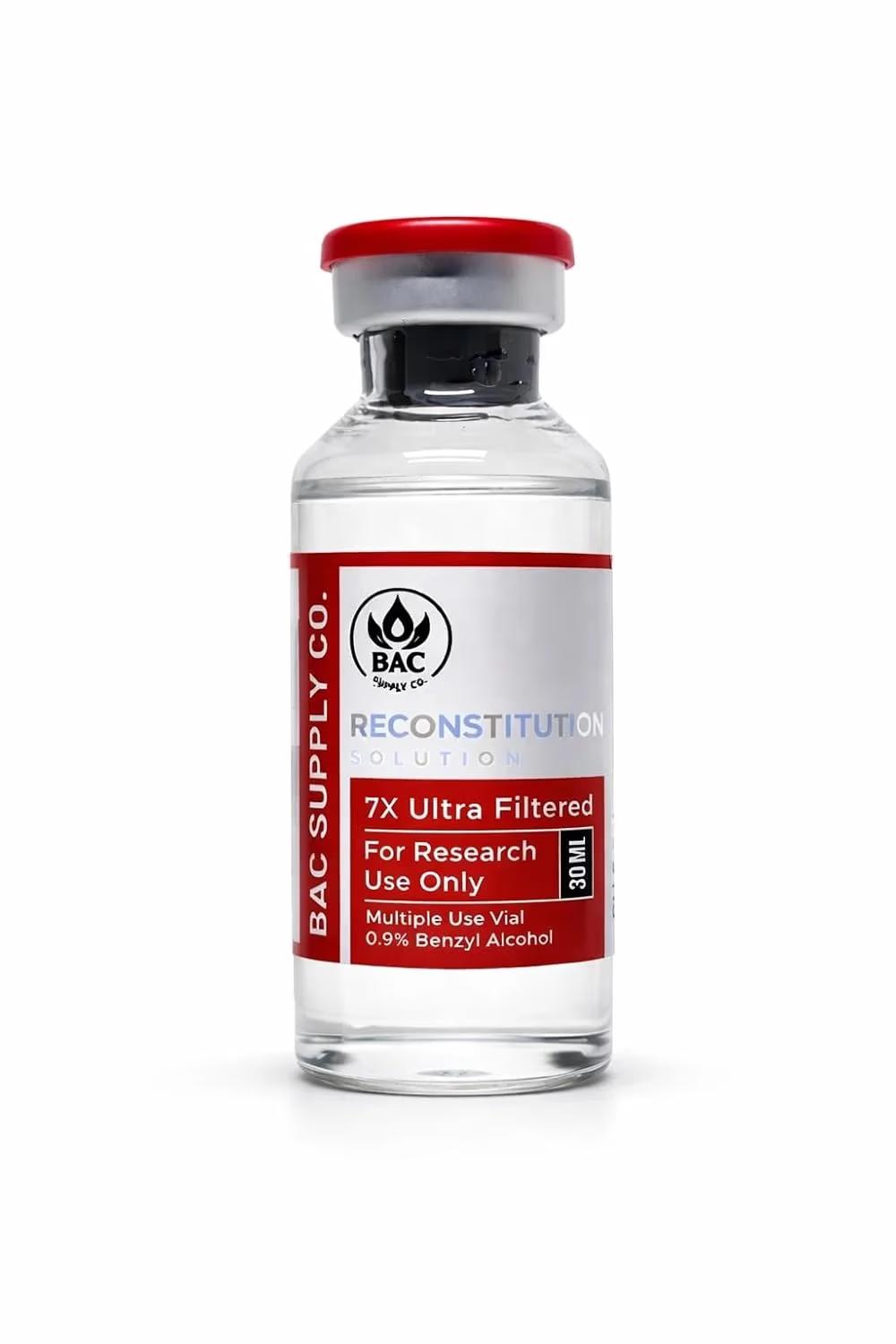
Bacteriostatic water is the diluent behind nearly every reconstitution step in this catalog, and the detail that distinguishes it from other diluents is a single added ingredient.
What makes it "bacteriostatic"
Bacteriostatic water is sterile water with 0.9% benzyl alcohol added as an antimicrobial preservative. That preservative is what allows a single vial to be punctured and drawn from repeatedly over its labeled use period — commonly 28 days from first puncture, based on validated preservative-efficacy testing — without the bacterial-growth risk that a non-preserved diluent carries once its seal is broken.
How it compares to other diluents
Sterile Water for Injection contains no preservative and is labeled strictly for single use: once a vial is punctured, it's discarded after that one draw. Normal saline (0.9% sodium chloride) also carries no antimicrobial preservative, but unlike either water-based diluent it's isotonic — matched to physiological osmolarity — which some protocols specifically require regardless of how many times a vial will be accessed. Benzyl alcohol, while broadly compatible with most lyophilized peptides, is not universally inert: a small number of compounds are noted in manufacturer or compounding-pharmacy literature as sensitive to benzyl alcohol-containing diluents, which is worth checking against a specific compound's documented reconstitution guidance before assuming interchangeability.
| Diluent | Preservative | Typical use pattern |
|---|---|---|
| Bacteriostatic Water | 0.9% benzyl alcohol | Multi-use vial over its labeled use period |
| Sterile Water for Injection | None | Single-use; discarded after one draw |
| 0.9% Sodium Chloride (saline) | None | Single-use; isotonic where that property is required |
Reconstitution volume and concentration
How much bacteriostatic water goes into a given vial is a concentration decision, not a dosing one: adding more diluent doesn't change how much active compound the vial holds, only how concentrated each milliliter is and how large a given draw appears on a syringe. A more dilute reconstitution can make small draws easier to read accurately on a syringe barrel; a more concentrated one reduces the injection volume per draw. Neither changes the total amount of active compound in the vial — only its distribution across volume.
Like every other product in this catalog, each batch of bacteriostatic water carries its own certificate documenting sterility and benzyl-alcohol concentration — worth checking alongside the compound it will reconstitute rather than assuming the diluent is interchangeable across suppliers.
Every reconstitution figure in our reconstitution guide works from the concentration you supply — it converts units, it doesn't originate a dose.