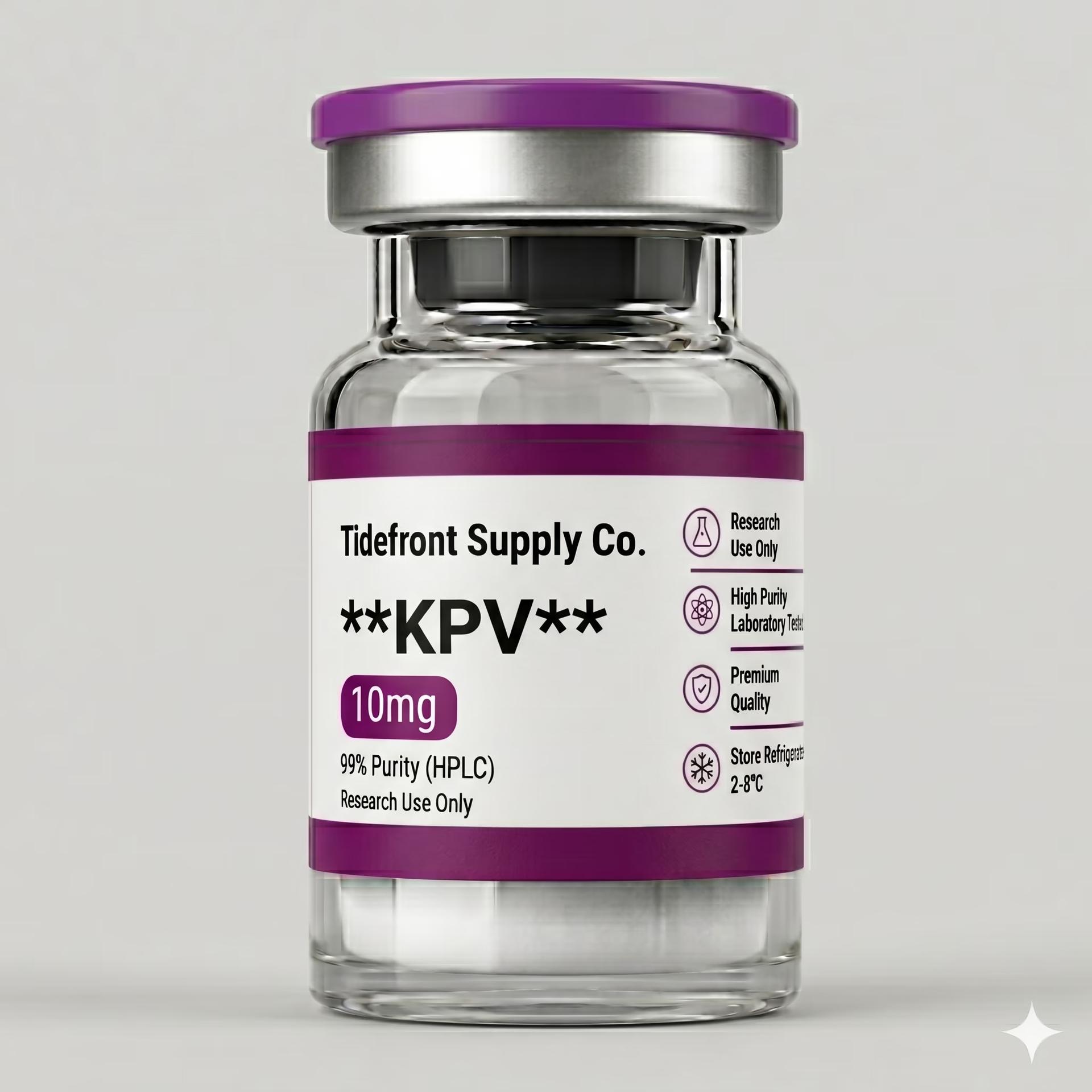
KPV is a tripeptide — lysine, proline, valine — named directly for its single-letter sequence. It is the C-terminal fragment of alpha-melanocyte-stimulating hormone, which is where its research interest originates — the smallest piece of that hormone still studied in its own right, and short enough to be made by routine solid-phase synthesis. It is supplied here as lyophilised powder for laboratory work.
Identity and characterisation
The tripeptide is registered under CAS number 67727-97-3 and indexed as PubChem CID 125672. Its molecular formula is C16H30N4O4, the molecular weight is 342.43, and the InChIKey is YSPZCHGIWAQVKQ-AVGNSLFASA-N — a mass consistent with three residues of this composition, which is an arithmetic check worth running against any certificate of analysis before a molar calculation is made from it. Written out in full the compound is L-Lysyl-L-prolyl-L-valine; the shorthand Lys-Pro-Val is the form most likely to return peptide literature. Two positional names also circulate, alpha-MSH (11-13) and ACTH-(11-13), reflecting the two parent numbering schemes the fragment inherits, and older Russian and European sources use the first of those. The bare three letters are the weakest search term of the set — the sequence, the CAS number or the InChIKey will separate this peptide from unrelated material faster.
Research context
The indexed work approaches KPV from two directions. One paper examined uptake of the tripeptide through the PepT1 transporter and its relation to intestinal inflammation, which is the transporter-level account of how a peptide this small enters intestinal epithelium at all.
The remaining citations concern the parent hormone rather than the fragment. One review covered alpha-MSH and inflammation, describing both peripheral and central anti-inflammatory effects reported in the literature; another covered melanocortin receptors as potential therapeutic targets. An experimental paper examined evidence for autocrine modulation of macrophage nitric oxide synthase by alpha-MSH, and a further study examined alpha-MSH in experimental models of inflammatory bowel disease. Read together, these establish the context KPV was drawn from rather than testing the tripeptide itself — a distinction the citation list makes plain once you notice how many of the titles name the hormone and not the fragment.
Evidence status
Our reference grades this entry as reported practice, with no study establishing it. What sits under that heading is not a protocol but a conversion table: rows for 200, 300, 400 and 500 mcg, each mapped to a volume and to units on a U-100 syringe, worked out for a 5 mg vial reconstituted with 1 mL and a 10 mg vial with 2 mL. The table converts a figure into a volume; it does not recommend the figure. No half-life for KPV is held on file, and none is stated. The table is reproduced at .
We stock 10 mg and 12 mg vials, and the 12 mg size matches neither row of the reference's worked example, so its arithmetic has to be redone rather than read across — https://tidefrontsupply.com/tools/reconstitution does that from the vial mass and whatever diluent volume you enter, both treated as inputs. Sealed vials are kept cold and shielded from light. Bacteriostatic water goes in slowly against the glass; the vial is swirled, not shaken; the solution afterwards stays refrigerated, dark, and clear of repeated freeze-thaw cycles. There is no KPV-specific page in the calculator.
What we supply
Two lyophilised presentations: 10 mg under TIDE-KPV-001 and 12 mg under TIDE-KPV-002. Each batch is intended to ship with a certificate of analysis, which is the document tying a particular vial to the identifiers set out above. The 99.0% mean HPLC purity figure we publish is a catalogue-wide mean of ours, quoted as such.
Research use only — not for human or veterinary use.